

|
|
|
What Do We Know About John Martin's Ancestors? Our primary source of information about John and Sarah's forbears is the letter of Elza Martin, written decades after their deaths. The narrative presented there is clearly stated and compelling, yet it poses certain problems. Chief among these is its lack of specifics, such as dates and places, which could be used to verify and supplement the information it gives. Elza's letter names Edward Martin as John's father, and that name also appears in Charles M. Walker's History of Athens County, identifying him as one of the earliest inhabitants of Alexander Township. However, we have not found the name Edward Martin on any property deeds filed either in Athens County or in Washington County (from which Athens Co. was formed), nor does he show up in any censuses of Athens County, and I don't believe any such person is shown in the 1790 census of Pennsylvania (where John was born in 1789*). The census does show one man in Washington County, PA, whose name might be interpreted as Edward Martin, but I don't accept that interpretation. I also reject the idea that a certain Edward Martin known to have lived in Hampshire County, [West] Virginia, could have been John's father. For those who care, I have laid out my reasons below for rejecting these two possible fathers for John. It seems clear to me that the name Edward is simply a misinterpretation — that John's father was commonly known as “Ed” or “Eddie,” and his friends and even some family members simply assumed that the name was short for Edward. Listings of adult males in Washington County, Ohio, compiled in 1800 and 1803, show the names Edmund and Edmond Martin, respectively, and it is likely that one of these is the correct name of John's father. In both cases, the individual named resided in Middletown Township, which was in the part of Washington County that later became Athens County. Moreover, Edmund Martin appears on a list of voters for an election in Alexander Township in October 1805. In addition, Rufus Putnam's list of some of the earliest applicants for land in the "south university township" (which later became Alexander Township) shows that Edmond Martin applied for 120 acres in the southeast corner of Section 23 (see page 2 here). It seems odd, therefore, that W. E. Peters' map of the original settlers of Alexander Township assigns this same land to Moses Hewitt. This situation is clarified, however, by a document from June 1807 which transfers the lease on this property to Hewitt as an “assignee of Edmund Martin,” retroactive to 1 January 1806. The document doesn’t specify how Hewitt came to be an “assignee,” but I suspect it was done either because Edmund had died or because he found himself too sick and feeble to work the land, and initiated the reassignment himself before he died. Either way, I think he had passed on by the time the reassignment was formalized in 1807, as the leasing document includes no statement from him consenting to the arrangement. Edmond Martin also is listed in the 1790 Federal Census in Union Township, Fayette County, Pennsylvania. His household in that census included three females (ages not stated), two men more than 16 years old, and one male child less than 16 (who could be John). Edmond or Edmund Martin is further documented in tax lists for Union Township, Fayette County, in 1786, '87, and '88. Tax lists are lacking for most of the 1790s, but Edmond does not appear in the county's Direct Tax Files for 1798, suggesting that he already had emigrated to Ohio by that time. In fact, according to the "Descriptions of land granted to settlers in . . . the Ohio Company Donation Tract," Edmund Martin was granted 100 acres of land in northern Washington County, Ohio, in April 1797. This was not in the part of Washington County that became Athens County, but then Washington County deed records show that Edmund turned around and sold this same land the following September. By 1800, as noted above, he had moved to the area of the future Athens County. New information added in 2026:
John Martin's grandfather (Edmond's father?) was another man also named John Martin who, according to Elza's letter, lost his life at the hands of hostile Indians. Elza also asserts that this John Martin "lived in what is now West Virginia before the Revolutionary War." Unfortunately, there is no comprehensive census of Virginia from Colonial times, and other written records are spotty. Rent rolls recorded in 1764 show that a man named John Martin then lived in Frederick County, VA, which is not one of the counties that became part of West Virginia, although it is bordered by the West Virginia counties of Berkeley and Hampshire. This John Martin easily could have relocated to one of those counties within a few years after 1764. Following the Revolution, the Commonwealth of Virginia conducted statewide censuses in 1782 and 1784 (which would have been after the elder John Martin's death). Both of these reported a household headed by one Edmund Martin in Hampshire County (which is now included in West Virginia). This household included eight "free white persons"; no ages or genders were listed. If this Edmund had been a minor when his father died "about 1774–1776," he could have been 20 or so by 1782. It seems questionable whether someone so young could have been the "head" of a household of eight, but he might have been counted as such if he were the only male or the oldest male in the family. If he is the person identified as "Edward" in Elza's letter, he reportedly had two older sisters, and his widowed mother was probably in his household. These would account for four people in the household; add a child or two and perhaps a hired hand or two, and this could have been a household of eight. Hence, it is feasible that our John Martin's grandfather — the elder John Martin — was in Frederick County, VA, in 1764; that he subsequently moved a few miles west, into Hampshire County; that he was killed there about 1774–76; and that his son Edmond grew to manhood there before moving to Fayette County, PA, about 1785. The documentary record, though, is distressingly thin. So far, I have found no historical accounts of a John Martin killed by Indians in the mid-1770s in Hampshire County or anywhere else in western Virginia. Surprisingly, there is a well-documented account of an Indian trader by that name killed in 1773, in the area that would later become Athens County, OH. However, the circumstances are completely different from those described in Elza's letter and, besides, that John Martin was known to be a young man, married less than a year, who left no children. It is clear, however, that there were many skirmishes between the Indians and white settlers all along the western frontier in 1774 and '75, during the conflict known as "Dunmore's War," and that British agents actually paid Indians to murder and scalp American frontiersmen in that area during the Revolutionary War. I'm sure that many such deaths were never recorded and/or that records have been lost over the intervening years. Obviously, I am still seeking further information about Edmund/Edmond Martin and the earlier John Martin. If you can provide any further details about these men, their wives, parents, or other family members, please contact me at the address shown in the image below:
Thanks,
Return to John Martin Family home page. *In the 1880 census, five of John's surviving children listed Pennsylvania as the place where their father had been born.
The 1790 census shows an individual in Washington County, PA,
whose name has been variously interpreted as Edward Martin
or Mortin or Morton. However, I do not
think the name is Martin, for two reasons: (1)
On a copy of the original document, the second and third letters
of the second name appear to be written differently from the
"ar" in the first name Edward and also differently
from the "ar" in the We also know of an Edward Martin who lived in Hampshire County, [West] Virginia, based on a will that was filed there in 1796. Interestingly, this will does name a certain "John Martin" as one of Edward's heirs. Nowhere, however, does the will identify this John Martin as "my son." Instead it thrice refers to him as "John Martin Son of Catherine Miller." Nevertheless, it's tempting to think that this will refers to "our" John Martin and that the man who made it was, indeed, his father Edward. I find that neither of these interpretations is credible. First, I note that the will names this same John Martin as one of the executors. Inasmuch as "our" John was only 7 years old at the time the will was made, no sensible person would have named him as an executor. Second, I have found another record showing that this Edward Martin purchased some land in Hampshire County in 1773. This would not have been feasible for a boy whom Elza describes as "a younger son" (i.e., not yet grown) when his father was killed about 1774–76.
|

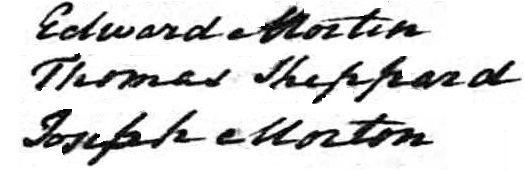 name Sheppard,
which appears farther down on the same page. In fact, they
seem essentially identical to the "or" in the name Joseph
Morton, which also appears farther down the page.
These three names, as reproduced from the census document, are
shown at right. (2) The name Edward Mortin also
appears in a listing of the "
name Sheppard,
which appears farther down on the same page. In fact, they
seem essentially identical to the "or" in the name Joseph
Morton, which also appears farther down the page.
These three names, as reproduced from the census document, are
shown at right. (2) The name Edward Mortin also
appears in a listing of the "